
Differential Pressure Gauge
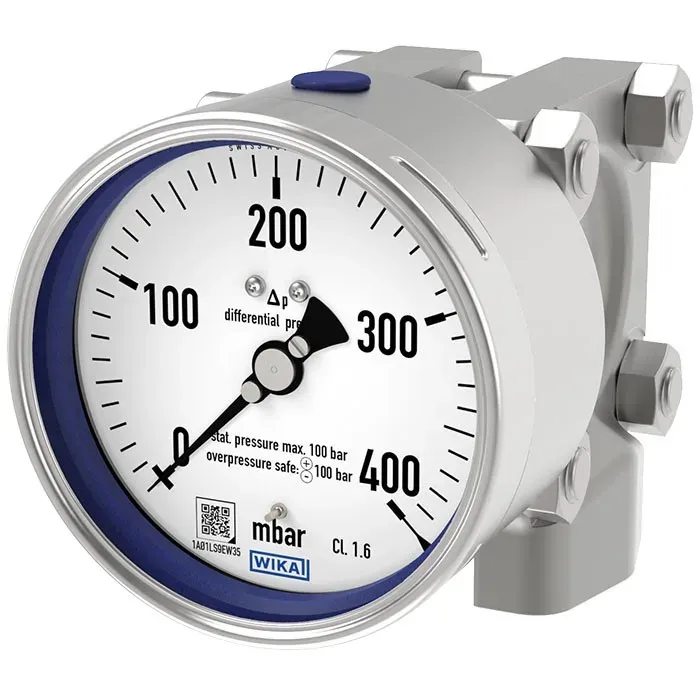
Local indication of the difference between two pressures: diaphragm-based DP gauges with ranges to 40 bar, selectable overload safety from 40 to 650 bar, EN 61518 flange or ½" and ¼" threaded connections, and 316L, Inconel, Hastelloy or Monel wetted parts.
Differential Pressure Gauge
A differential pressure gauge shows the pressure drop across a filter, strainer, heat exchanger or pump directly on the dial, without an electrical supply. A diaphragm separates the plus and minus chambers and its deflection drives the pointer; the measuring range applies to the difference, while the line pressure can be many times higher.
DP ranges run from −1 to +30 bar up to 0–40 bar, including vacuum and compound scales. What distinguishes a good DP gauge is its one-sided overload safety: selectable ratings of 40, 100, 250, 400 or 650 bar mean the gauge survives a valve sequencing error or a blocked leg. Accuracy is Class 1.6 or 2.5, with Class 1.0 achievable after application testing. Process temperature is −20 to +200 °C.
Connections are 2 × ½" or ¼" threaded (G or NPT), or a flange to EN 61518 for direct mounting on a 3- or 5-valve manifold. Wetted parts are 316L stainless steel, Inconel, Hastelloy C-276 or Monel. Options include SPDT/DPDT switch contacts, mounting brackets and overpressure protectors.
Applications cover filter and strainer condition, pump and compressor differential, flow indication across restrictions, and level in closed or pressurised vessels in chemical, petrochemical, oil and gas, water treatment and general process industries.
Pressure
Spec it with our engineers
Send us your process conditions and we’ll recommend the right configuration — with a quote inside one business day.