
Hydrostatic Level Transmitter
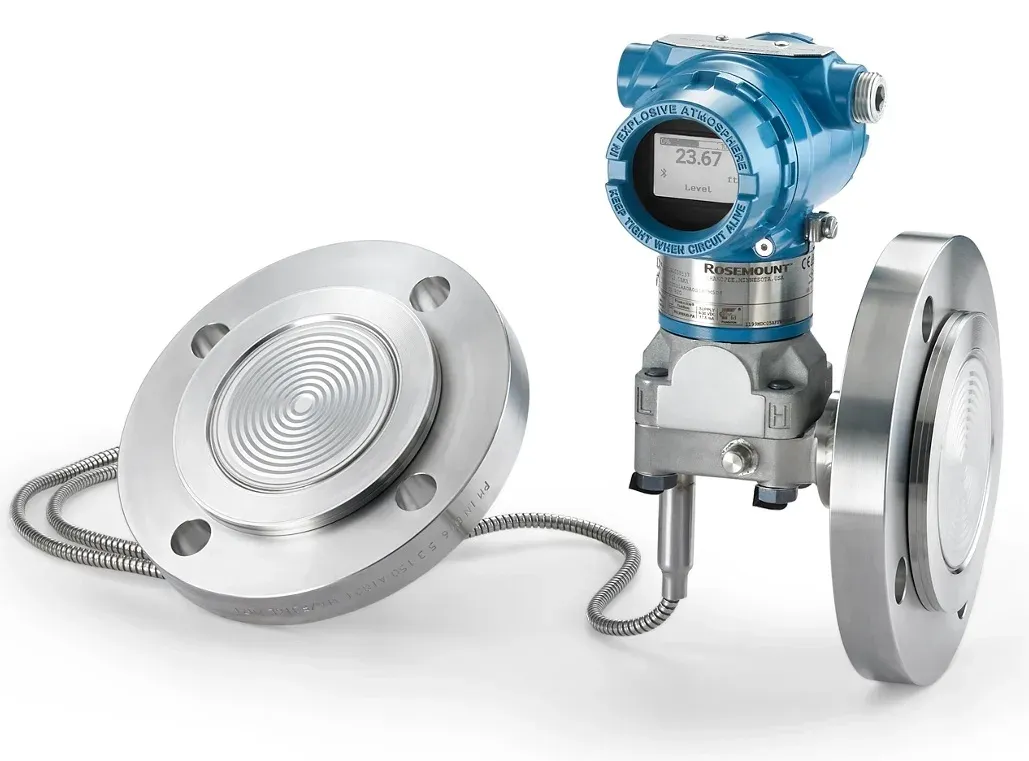
Level from pressure: a side-mounted flanged transmitter measures the hydrostatic head of the liquid column, with a diaphragm seal and capillary for pressurised or hot vessels. Ranges to 30 m, to 250 bar and 400 °C, in 316, duplex, Hastelloy, alloy or PTFE-coated, 4–20 mA HART or FOUNDATION Fieldbus.
Hydrostatic Level Transmitter
The hydrostatic method is the oldest and often the most economical way to measure liquid level: the pressure at the bottom of a tank equals the height of the liquid column times its density. A pressure transmitter mounted at the bottom nozzle reads the head directly in an atmospheric tank; in a pressurised vessel a differential pressure transmitter with a second connection to the vapour space subtracts the tank pressure. Either way the reading is unaffected by foam, vapour, turbulence or internal structures, and the transmitter is a standard, proven pressure instrument.
Transmitters cover level ranges up to 30 m at process pressures to 250 bar and temperatures to 400 °C. The flanged diaphragm seal is what adapts the instrument to the service: flush or extended diaphragms in 316, duplex, Hastelloy, other alloys or PTFE-coated for corrosive media, with fill fluids for temperature, oxygen or food service, and capillaries and extensions for remote mounting of the electronics away from hot or vibrating vessels.
Outputs are 4–20 mA HART or FOUNDATION Fieldbus. Because the measurement depends on density, the transmitter can be configured for the product's specific gravity, or paired with a second transmitter to compute density and mass.
Hydrostatic level transmitters serve atmospheric and pressurised tanks in oil and gas, petrochemical, refining, chemical, power, water and food and beverage, and are specified in preference to radar for viscous, foaming or coating products and for tanks with complex internals.
Level
Spec it with our engineers
Send us your process conditions and we’ll recommend the right configuration — with a quote inside one business day.