
Surface (Skin) Temperature Sensor
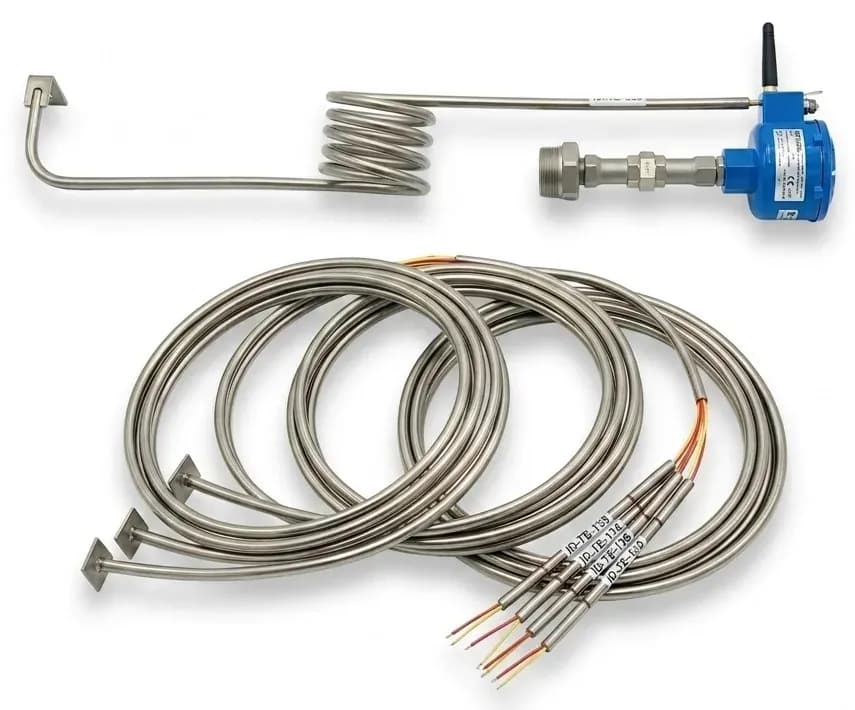
A Pt100 sensor that measures the temperature of a surface instead of a fluid: screwed or welded contact blocks, tightening straps or weld-on pads fix it to pipes, vessels and machinery. Standard to 250 °C, optional to 600 °C, in 316, Hastelloy or Inconel, with direct wiring or a 4–20 mA, HART or fieldbus transmitter.
Surface (Skin) Temperature Sensor
Not every temperature can be measured by inserting a probe. Skin temperature sensors are used where a process penetration is impossible or unwanted: heat-traced pipelines, reactor and furnace walls, heat exchanger shells, bearing housings, motors and transformer tanks, or product lines where the fluid must not be touched. They are also the standard way to verify heat-tracing performance and to monitor tube-wall temperature in fired heaters and reformers.
The element is a Pt100 RTD, single or dual, wired 2-, 3- or 4-wire, mounted in a contact block or pad that maximises thermal contact with the surface. Fixing options are a screwed or welded contact block, a tightening strap for pipes, or a weld-on pad for permanent installation on vessels and structures. Standard sensors measure up to 250 °C, with versions to 600 °C for furnace and high-temperature duty. Probe materials are 316 stainless steel, Hastelloy or Inconel, and accuracy is IEC 60751 Class B, A or AA depending on construction.
Output is the direct sensor signal or, via a head- or rail-mounted transmitter, 4–20 mA, HART, FOUNDATION Fieldbus or PROFIBUS. Accessories include contact blocks, straps, washers, weld-on pads, connectors and bend protectors for the lead.
Skin sensors are used in chemical, petrochemical, general industrial and laboratory applications, and are essential wherever surface temperature is a safety limit.
Sıcaklık

Mühendislerimizle birlikte belirleyin
Proses koşullarınızı iletin; doğru konfigürasyonu önerelim ve bir iş günü içinde teklif verelim.