
Transmitters
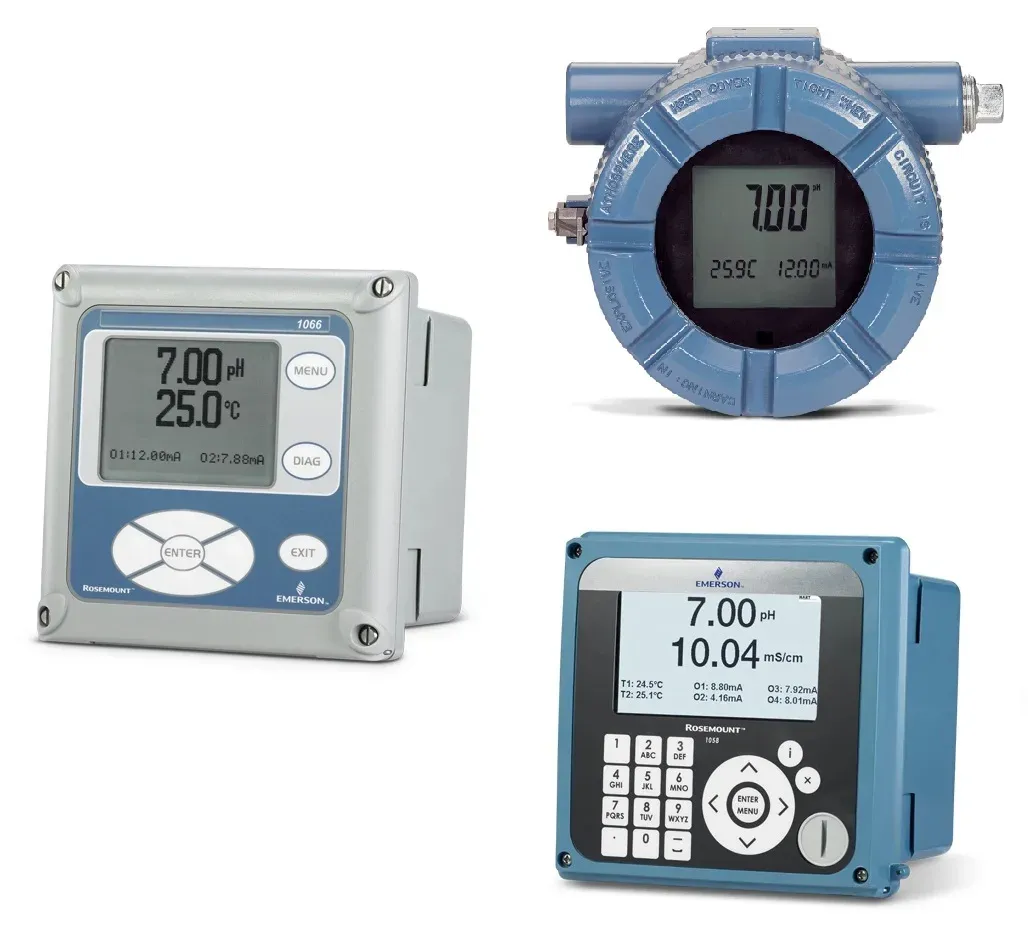
The electronics behind the sensors: single- or dual-channel liquid analytical transmitters that accept pH/ORP, conductivity, free and total chlorine, dissolved oxygen and ozone sensors, with temperature compensation, 4–20 mA, HART or FOUNDATION Fieldbus output, loop-powered or four-wire, for panel, wall or 2" pipe mounting.
Transmitters
An analytical transmitter turns the microvolt signal of a pH electrode or the picoamp signal of a chlorine cell into a scaled, compensated and diagnosed measurement. Modern transmitters are universal: one unit accepts any of the sensor families in this range, and the dual-channel versions measure two parameters, such as free chlorine and the pH needed to compensate it, or conductivity and pH on a demineraliser, with one enclosure and one power supply.
Transmitters accept pH/ORP, contacting conductivity, free chlorine, total chlorine, monochloramine, dissolved oxygen and ozone sensors, with temperature input and compensation for each. Outputs are 4–20 mA, HART or FOUNDATION Fieldbus depending on model, in a loop-powered two-wire configuration for the simplest installation or four-wire with relays for local control. Power supply is 12 to 26 VDC or 85 to 265 VAC. Mounting is panel, wall or 2" pipe, with weatherproof housings for the field.
Calibration is guided from the front panel, with automatic buffer recognition for pH, and sensor diagnostics such as glass impedance and reference impedance warn of a failing electrode before the measurement drifts.
The transmitters are supplied with the sensors and accessories from this range as complete measuring loops for chemical, power, water and wastewater, food and beverage and general process plants.
Analizör
Mühendislerimizle birlikte belirleyin
Proses koşullarınızı iletin; doğru konfigürasyonu önerelim ve bir iş günü içinde teklif verelim.